Knowledge base
Fire testing made clear. We explain the markings, standards and terms — so you know what the results mean and what to ask us.
What the letters in the classes mean
The fire resistance class is written using a combination of letters and numbers, e.g. EI 30 or REI 90. The letters say what properties the element fulfills, the number indicates the time in minutes.
- R — load-bearing capacity (ability to retain structural stability in a fire),
- E — integrity (prevents penetration of flames and hot gases),
- I — insulation (restricts heat transfer to the opposite side),
- W — limitation of radiation (radiation of heat),
- S — smoke control (e.g. Sa3, Sa4 or S200),
- C — self-closing (for doors and shutters, classes C0-C5),
- number — time in minutes (15, 30, 45, 60, 90, 120…).
How a fire is simulated in the furnace
A temperature curve is not a forecast of a particular fire. It is a precisely defined thermal load that makes test results comparable and classifiable. We select the curve according to the scenario the product has to withstand.
The laboratory does not choose the curve at will. The correct regime follows from the product, its intended use and the relevant test or classification standard — we therefore confirm it when preparing the test programme.
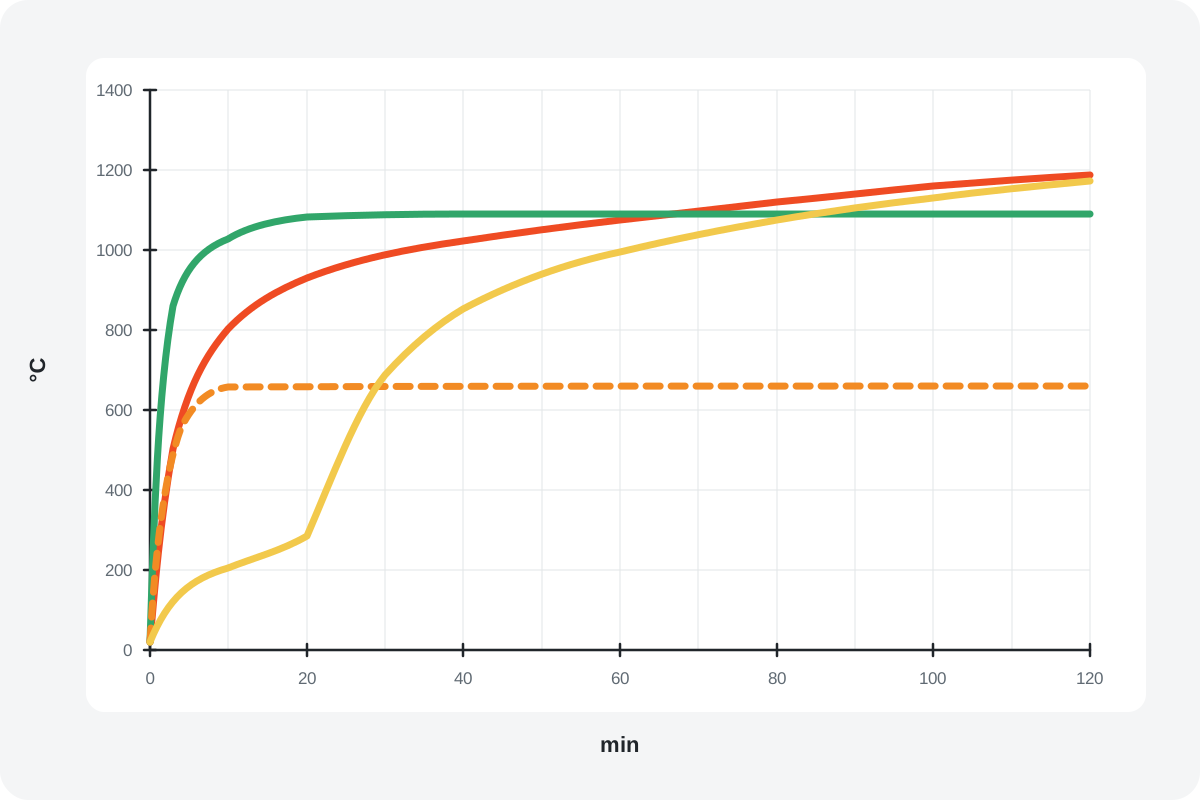
- Standard temperature curve
- External fire curve
- Hydrocarbon curve
- Slow heating
- Standard curve (ISO 834, ČSN EN 1363-1) — a fully developed fire in an enclosed space. The temperature rises quickly and keeps rising throughout the test; the most common scenario.
- External fire curve (ČSN EN 1363-2) — for structures exposed to fire from outside the building. After the initial rise the temperature levels off below the standard curve.
- Hydrocarbon curve (ČSN EN 1363-2) — an extremely rapid temperature rise typical of hydrocarbon fuel fires. Intended for specific applications, not as a general substitute for the standard curve.
- Slow heating — verifies products for which a longer initial phase at lower temperatures may be critical; only then does it move to higher thermal loading.
Classes of self-closing cycles (C0–C5)
The requirements for the number of self-closing cycles of fire shutters are set by the standard EN 16034 (Doors, gates and opening windows — product standard, functional properties — fire resistance and/or smoke resistance characteristics).
Specifically, the product feature “Self-sealing durability against degradation". It is verified by a cyclic test and the standard distinguishes six classes C0 to C5. The required class is determined by the designer in the fire safety solution (PBŘ) with regard to the frequency of use.
| Category of use | Cycles |
|---|---|
| C5 | ≥ 200 000 |
| C4 | ≥ 100 000 |
| C3 | ≥ 50 000 |
| C2 | ≥ 10 000 |
| C1 | ≥ 500 |
| C0 | 1 to 499 |
Abbreviations and terms
Brief explanations of the concepts you will encounter in the preparation of the test, classification and marketing of the construction product.
- Accreditation
- Independent confirmation of the laboratory's professional competence for specific activities. AFIRE is accredited by ČIA according to ČSN EN ISO/IEC 17025.
- Authorized person
- Entity authorized to act according to Czech legal regulations. It is not automatically the same as a notified body operating under the European CPR.
- AVCP / AVS
- Assessment and Verification of Constancy of Properties (AVCP) is a designation used in particular under CPR 305/2011. The new CPR 2024/3110 uses the broader term assessment and verification systems (AVS). The system determines the division of tasks between the manufacturer and the notified body.
- CE marking
- It states that the manufacturer has taken responsibility for the conformity of the product with the declared properties according to the relevant harmonised rules. It is not a mark of quality in itself.
- Product certificate
- Document issued by the relevant certification body in the downstream process. AFIRE is preparing to expand to a certification body.
- CPR - Construction Products Regulation
- Regulation (EU) 2024/3110 applies from 8 January 2026. However, due to transitional provisions, selected parts of Regulation (EU) 305/2011 and existing harmonised standards remain applicable to the products concerned until they are replaced; full repeal of selected provisions is set for 2040.
- ČSN EN
- European standard adopted into the system of Czech technical standards. The label does not automatically mean that it is a harmonised standard under the CPR.
- ČIA
- Czech Institute for Accreditation, the national accreditation body of the Czech Republic.
- DIAP / direct application
- Rules for direct application of results given in the test standard. They define changes that can be accepted without further test; the label direct field of application is also commonly used.
- DoP
- Declaration of properties (Declaration of Performance) issued by the manufacturer under specified conditions. It lists the declared properties of the product and the underlying harmonised technical specification.
- EAD
- European Assessment Document (European Assessment Document). It serves as a basis for issuing an ETA for products that are not fully covered by the harmonised standard.
- EOTA
- European Organization for Technical Assessment. It coordinates the creation of EAD and the system of European technical assessments.
- ETA
- European Technical Assessment (European Technical Assessment). At the request of the manufacturer, they are issued by the technical assessment body based on the relevant EAD.
- ETAG
- Older directive for European technical approval. Some ETAGs are used as EADs in transitional mode; new documents are handled with the EAD designation.
- EXAP
- Extended application of test results (extended application). According to the rules of the relevant standard, it allows the use of test data also for defined variants of the product. The ČSN EN 15269, ČSN EN 15254 and ČSN EN 15882 series are used for individual product groups.
- FPC
- Factory Production Control. It is a permanent internal control of the manufacturer, which helps to maintain the characteristics of mass-produced products.
- Harmonised technical specification
- According to CPR, it is a Harmonised European Standard or EAD. It establishes a common technical basis for the assessment and declaration of properties.
- Harmonised standard
- European Standard produced at the request of the European Commission and cited for CPR purposes. Annex ZA is important for its use when placing the product on the market.
- hEN
- Common abbreviation for harmonised European standard.
- ITT
- Initial Type Testing, older designation of initial type testing. In CPR terminology, Product Type Determination and Performance Assessment are more commonly used, but the ITT abbreviation remains widespread in practice.
- ITT report
- An older practical term for a report or set of results from initial type testing. The exact title and applicability of the document depends on the AVCP standard and procedure.
- Classification
- Class assignment based on test results and classification standard rules, such as EI 30 or EW 60.
- Classification report
- A document that, based on test results and the rules of the classification standard, determines the achieved class and the scope of its validity. It can serve as a basis for subsequent assessment in the certification process.
- Climate class
- It defines the environmental conditions for which the product is intended or assessed. Specific meaning and markings vary by product standard.
- Conditioning
- Stabilisation of the sample under prescribed conditions prior to testing, for example in terms of temperature, humidity or age of the material.
- Smoke control
- The ability of the closure to limit the ingress of gases and smoke under defined pressure and temperature conditions.
- NANDO
- The European Commission's official database where notified bodies and the scope of their notifications can be verified.
- Notification
- The process of notification of an eligible entity to the European Commission for specific activities according to the harmonization regulation. The scope of the notification is always objectively defined.
- Notified Body
- An independent third party notified by a Member State to the European Commission for defined tasks under the CPR. The scope of activities of each notified body is published in the NANDO database.
- Support structure
- The structure in which the test specimen is mounted. Its type, stiffness and connection method can affect the result and the extent of its use.
- Fire resistance
- The ability of a building element to perform the required functions during a fire, for example integrity, insulation, radiation or load-bearing capacity, for a specified period of time.
- Test report
- A laboratory document describing the sample tested, the method used, the course and results of the test. It can serve as a basis for subsequent assessment in the certification process.
- Reaction to fire (A1–F)
- It describes how a material or product contributes to the origin and development of a fire. This is a different property than structural fire resistance and is not tested by AFIRE in the tests presented here.
- Sa3 and Sa4
- Smoke control classes related to ambient temperature testing. For Sa3 three joints are assessed without assessing the threshold joint; at Sa4 all four joints are assessed.
- S200
- Smoke control class including testing at elevated temperature. The measured flow rate through leaks at determined pressure differences is evaluated.
- TAB
- A technical assessment body (Technical Assessment Body) that can issue ETAs for defined areas of products.
- Temperature curve
- The temperature course over time prescribed by the standard, according to which the fire-resistance furnace is controlled. It allows you to compare the results of different tests.
- Thermocouple
- A temperature sensor used to measure the temperature in the furnace and on the surface of the test sample.
- Product type
- A set of representative levels or classes of properties corresponding to a particular product made from given raw materials and by a particular manufacturing process.
- Test sample
- The particular assembly submitted for test. Its dimensions, composition, fittings, anchoring and assembly determine the usability of the result.
- Intended use
- Use of the product envisaged by the manufacturer according to the relevant technical specification. It affects the choice of test, classification and declared properties.
Overview of important standards
Basic standards you will encounter when testing fire resistance, smoke control, product classification and laboratory competency assessment.
- EN 13501-2
- Classification standard for fire resistance of building products and structures based on relevant test results and extended application.
- EN 1363
- A number of general requirements for fire resistance tests. EN 1363-1 sets out general requirements, EN 1363-2 alternative and supplementary procedures.
- EN 1364
- A range of test methods for non-load-bearing elements such as walls, partitions and ceilings. AFIRE only tests configurations appropriate for its vertical furnace and scope of accreditation.
- EN 1365
- A series of test methods for load-bearing elements. This series is not part of the currently presented AFIRE range; the laboratory does not test horizontal structures or ceilings.
- EN 1366
- A range of fire resistance tests of operational installations such as penetrations, seals and other installation systems.
- EN 14600
- A standard for fire resisting and/or smoke control door and window assemblies that addresses self-closing durability requirements and classification.
- EN 16034
- Harmonised product standard for doors, gates and opening windows with fire resistance and/or smoke resistance.
- EN 1634
- A series of fire resistance and smoke control tests of doors, shutters and fittings. EN 1634-1 covers fire resistance and EN 1634-3 smoke control.
- EN 15254
- A series of standards for the extended application of the results of fire resistance tests of non-loadbearing walls. The specific part is chosen according to the type of construction under consideration.
- EN 15269
- A series of standards for the extended application of the results of fire resistance and/or smoke control tests of door and window assemblies including opening elements.
- EN 15882
- A series of standards for the extended application of fire resistance test results of operational installations. The specific part is chosen according to the type of penetration or system.
- ISO/IEC 17025
- An international standard establishing requirements for the competence, impartiality and consistent performance of testing and calibration laboratories.
Didn't find the answer?
Ask us directly — we will be happy to advise you on a specific product and procedure.